

 Share
Share 


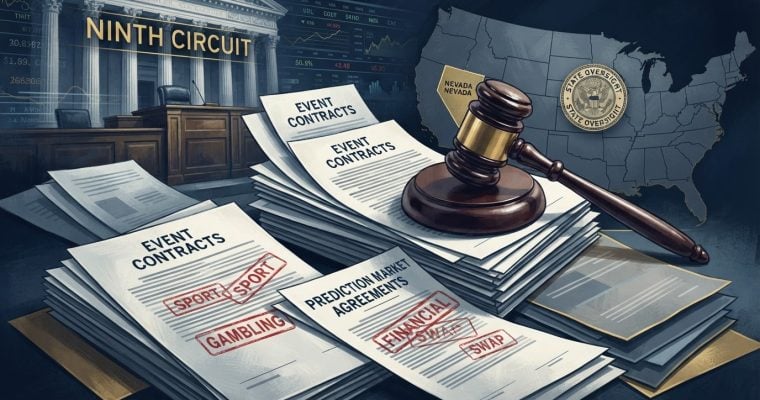
A federal appeals court has sided with Nevada regulators in their dispute with Kalshi over sports event contracts, a decision that adds to the growing legal split over who controls these products.
The Ninth Circuit Court of Appeals upheld Nevada gaming oversight of sports-related betting and rejected Kalshi’s argument that the contracts should be treated as financial swaps. According to _TheLines_, the 3-0 ruling is the latest major development in the broader fight between state regulators and prediction markets.
Court says sports event contracts are still sports gambling
In the opinion, Circuit Judge Ryan Nelson said sports event contracts are “sports gambling” regardless of how Kalshi labels them. He also wrote that Kalshi users can “effectively place prop bets, bet the point spread, bet a specific score, or create a several-leg parlay,” with payouts tied to team or player performance.
That reasoning cuts against Kalshi’s position that the products belong under federal commodities regulation alone. The article notes that event contracts are currently regulated by the Commodity Futures Trading Commission under the Commodity Exchange Act and are not subject to state tax.
Prediction markets including Kalshi and Polymarket have expanded into sports in recent years, and the source says both now accept parlay-style “combo” bets.
Nevada ruling adds to a widening legal conflict
The Nevada result does not end the broader dispute. _TheLines_ contrasted the Ninth Circuit outcome with an earlier federal appeals court ruling in New Jersey that said the New Jersey Division of Gaming Enforcement could not regulate Kalshi’s sports trades.
That split is one reason the article suggests the issue could move toward a U.S. Supreme Court showdown.
The source also outlined a recent Nevada timeline: the Nevada Gaming Control Board issued a cease-and-desist letter to Kalshi in March 2025, and Kalshi later sued the state. Kalshi was granted an injunction in April 2025 blocking the NGCB’s suit. More recently, Nevada extended its prediction market ban to Polymarket in June 2026, and lawmakers introduced a bill in July 2026 to ban sports on prediction markets.
Why New York bettors should watch the case
This ruling does not directly change New York’s online sports betting market. But it is part of a national fight over whether sports event contracts are gambling products overseen by states or federally regulated market instruments.
For New York players, the main takeaway is that the rules around prediction-market sports products remain unsettled and could keep changing as states, regulators, and courts continue to clash. The next key development to watch is whether the current conflict between court rulings in different jurisdictions draws review from the U.S. Supreme Court.
—
Source: As reported by thelines.com.