

 Share
Share 


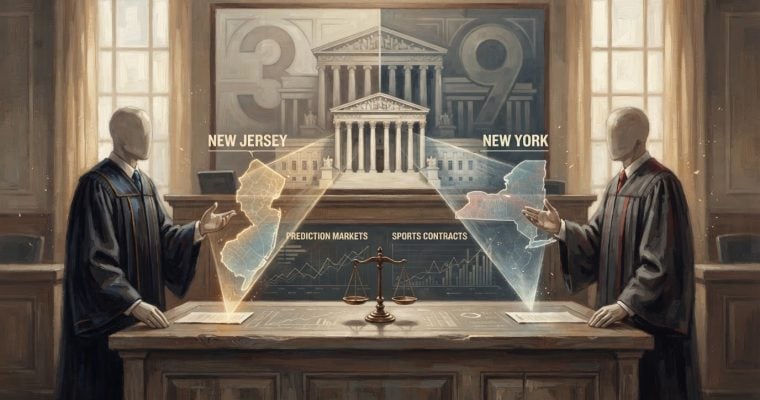
New Jersey has asked the U.S. Supreme Court to hear its dispute over prediction markets like Kalshi, escalating a legal fight that also matters in New York, where state officials have separately sued Kalshi over alleged illegal, unlicensed gambling.
The petition follows a split between two federal appeals courts on a central question: whether states can police sports-related event contracts offered on prediction platforms, or whether that authority belongs exclusively to the Commodity Futures Trading Commission.
Conflicting court rulings pushed New Jersey to seek Supreme Court review
According to the source report, New Jersey filed its request after the 9th U.S. Circuit Court of Appeals ruled on Aug. 28 against platforms like Kalshi in a dispute involving Nevada regulators. The 9th Circuit said Kalshi had not shown it was likely to prove that federal regulation overrides state officials when it comes to sports-related event contracts.
That conflicts with an April ruling from the 3rd U.S. Circuit Court of Appeals, which sided with Kalshi in its lawsuit against New Jersey. In that case, the 3rd Circuit found that federal regulators retain exclusive oversight of prediction markets, including sports-related contracts.
New Jersey Attorney General Jennifer Davenport said the split has “tremendous importance” and argued it will determine whether a “multi-billion-dollar” gaming industry can operate outside state sports-gaming laws.
Where New York fits into the broader prediction market crackdown
New York is one of several states that have moved against prediction market operators. The source report says New York sued Kalshi, alleging its prediction market amounts to illegal, unlicensed gambling. Connecticut has also sued Kalshi, while Minnesota and Arizona have been involved in separate court fights tied to state enforcement.
Kalshi maintains that its sports-related contracts are swaps rather than gambling products and says it is regulated federally as a Designated Contract Market. Spokesperson Dani Lever said the company is “an open, nationwide financial exchange” that cannot be regulated by 50 different regulators, and said the 3rd Circuit and the District of New Jersey both found that CFTC oversight preempts state law.
What players should watch next
The immediate next step is whether the Supreme Court agrees to hear New Jersey’s petition. If the justices take the case, the result could help clarify how far states such as New York can go in treating sports-related prediction contracts as gambling activity under state law.
For now, the legal picture remains unsettled, with different federal courts reaching different conclusions on the same issue.
—
Source: As reported by ca.finance.yahoo.com.