

 Share
Share 


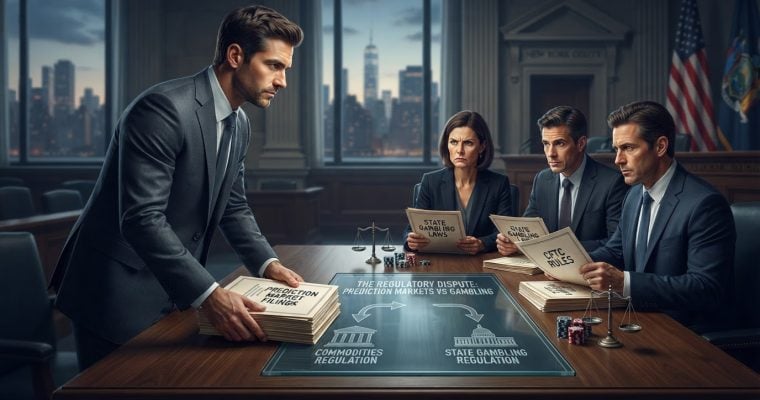
Kalshi has expanded its lobbying footprint in New York as prediction market companies escalate a broader legal and political fight over whether their platforms fall under state gambling laws or federal commodities rules.
According to reporting from _St. Joseph News-Press_, Kalshi, Polymarket and the Coalition for Prediction Markets spent at least $3 million in 2026 on lobbying and campaign contributions while states and the Commodity Futures Trading Commission continue to clash over who regulates the industry.
New York becomes part of Kalshi’s larger state push
The report says Kalshi increased its monthly payment to Brown & Weinraub Advisors in New York from $10,000 to $25,000. It also hired the Mirram Group for another $25,000 per month through July 2027 and registered Blake Bee as an in-house lobbyist to work on the governor’s office and state assembly through December 2026.
Based on those filings, Kalshi was projected to spend more than $400,000 on lobbying in New York through July 2027.
That state-level activity fits into a much larger campaign. As of September, Kalshi had at least one registered lobbyist in 41 states, most of them hired since April. In California alone, it spent $62,000 on lobbying in the first half of 2026.
The bigger fight is whether prediction markets are gambling
The core dispute is whether prediction market contracts should be treated as CFTC-regulated swaps or as gambling products that states can restrict or ban.
The article notes that several cases over whether state law applies to prediction markets are already in federal court and are moving toward the Supreme Court. It also says the CFTC has sued states that tried to enforce gambling laws against prediction market platforms, an action attorney Brad Lipton called "unprecedented."
The regulatory debate has drawn strong criticism from state officials. A coalition of 44 state attorneys general described prediction markets in a July letter to the CFTC as a "new form of casino."
What New York readers should watch
For New York readers, the main takeaway is that the fight is no longer only happening in Washington. Kalshi is spending heavily to influence state policymakers while courts sort out whether prediction markets can operate outside traditional state gambling frameworks.
The next developments to watch are any New York policy response, further court rulings on state authority, and whether other prediction market operators follow Kalshi’s lead with expanded state lobbying.
—
Source: As reported by newspressnow.com.