

 Share
Share 


A new federal appeals court ruling has intensified the legal battle over prediction markets tied to sports, a dispute that matters in New York because the state is already involved in related litigation.
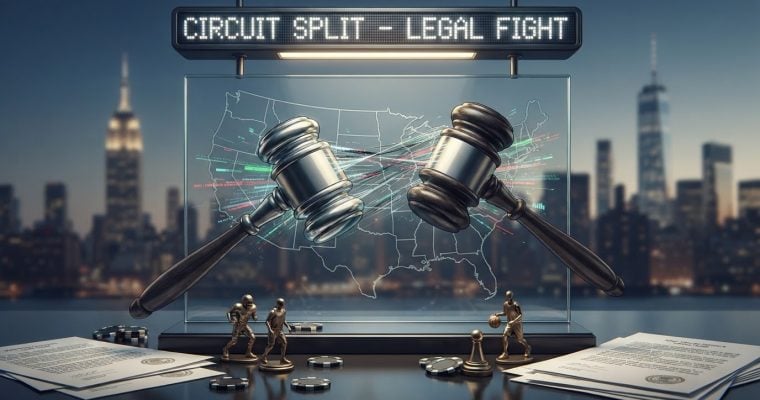
On Aug. 28, the US Court of Appeals for the Ninth Circuit ruled 3-0 against Kalshi in _KalshiEX, LLC v. Assad_, holding that sports event contracts are not swaps under the Commodity Exchange Act and that federal law does not preempt state gambling regulation. That directly conflicts with a prior Third Circuit ruling in Kalshi’s favor, creating a confirmed circuit split.
Ninth Circuit ruling raises the stakes for state enforcement
The broader fight centers on whether the Commodity Futures Trading Commission has primary authority over these contracts or whether states can apply their own gambling laws.
According to the source material, 19 states are now involved in legal proceedings related to prediction market platforms. Washington, Massachusetts, Michigan, and Nevada have filed civil suits against operators over sports event contracts. Arizona has pursued criminal charges, while Minnesota has sought to prohibit prediction markets in the state.
New York is also part of the legal picture. Kalshi has brought actions against New York and several other states, while the CFTC has separately sued New York along with Arizona, Minnesota, Wisconsin, Illinois, and Connecticut.
The market has grown quickly as the legal questions have piled up. Prediction market trading volume reached $51 billion in 2025, and Bernstein Research estimated the sector could hit $240 billion by the end of 2026. Sports event contracts have made up about 80% of Kalshi’s total volume since July 2024.
CFTC rulemaking could shape what contracts are allowed
The court fight is only one track. On June 10, 2026, the CFTC issued a notice of proposed rulemaking to amend Rule 40.11 and add a new Appendix F under the Commodity Exchange Act. The public comment period closed July 27.
That process could help determine what kinds of sports-related event contracts may be offered going forward. It has already drawn pushback from states: 44 states submitted a joint letter disputing the CFTC’s authority to regulate sports-related event contracts.
Leagues are paying attention too. The NFL asked Kalshi and Polymarket to avoid markets it said were susceptible to manipulation, and the NCAA called on the CFTC to pause college sports event contracts until "appropriate regulations" are in place.
What New York readers should watch next
The biggest unresolved question is whether the US Supreme Court will step in after the circuit split. The source also points to pending appeals in the Fourth and Sixth Circuits, plus the CFTC’s still-unfinished rulemaking.
For New York readers, the main takeaway is simple: the rules around sports event contracts are still unsettled, and the outcome could affect how states, regulators, and platforms divide authority in the years ahead.
—
Source: As reported by Javier Cora, Stephen Cosenza Jr., Eric Forni, Chas Hamilton, Bing Sun, Brian Wilmot.