
coinbase prediction markets (2026)
Coinbase prediction markets let US users buy and sell contracts tied to the outcome of real-world events, from sports scores to Fed rate decisions to crypto price levels at a specific time. The contracts trade on Coinbase’s app and site, but they’re actually operated by Kalshi, a CFTC-regulated exchange, through Coinbase Financial Markets (CFM). Coinbase provides the interface; Kalshi runs the market and settles every trade.
How Coinbase prediction markets work
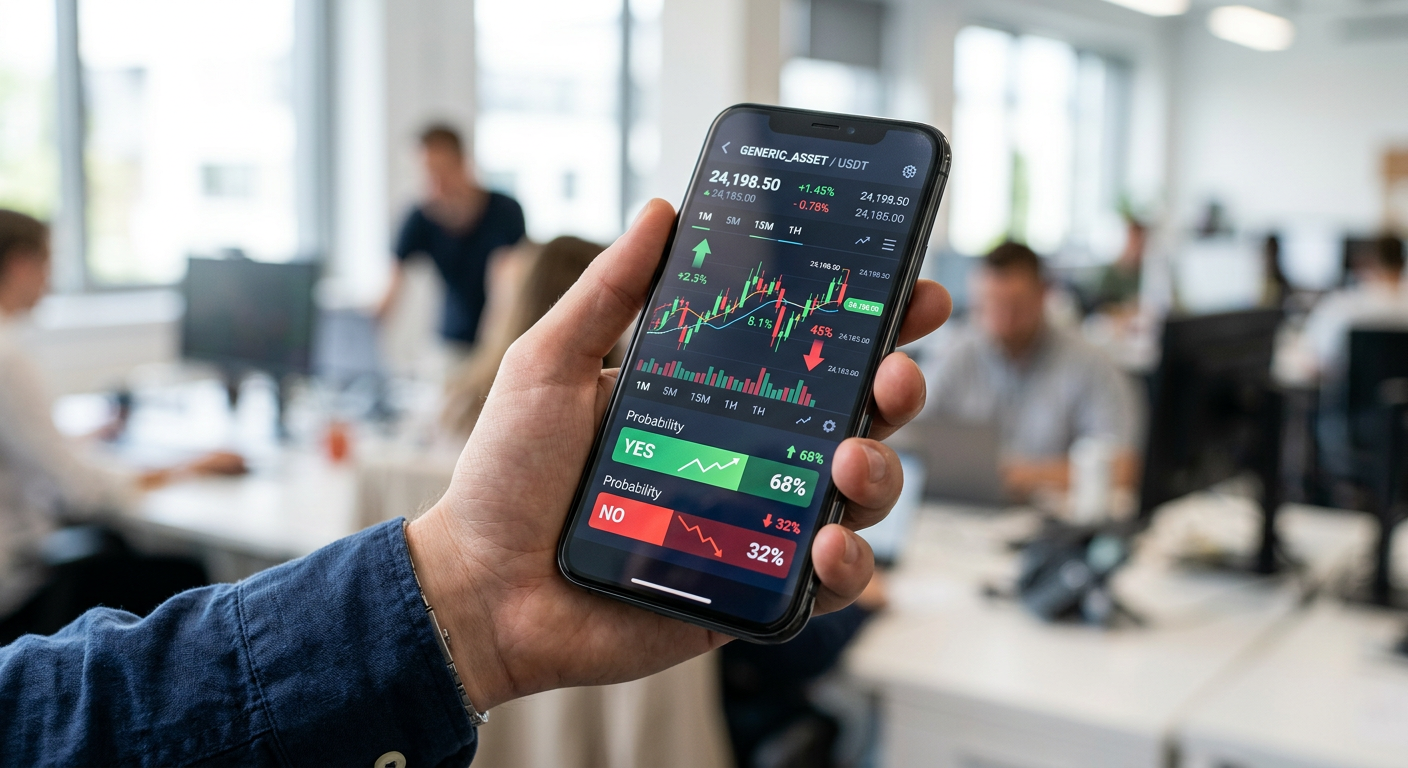
Each market asks a yes/no question about a future event: will the Fed cut rates in December, will the Chiefs win by more than 3.5 points, will Bitcoin close above $100,000 by Friday. You buy a contract on the outcome you think will happen. The price of that contract, somewhere between 1 cent and 99 cents, reflects the market’s implied probability of that outcome.
If your side wins, each contract pays out $1. If it loses, the contract settles at $0. There’s no partial credit and no floating value once the event resolves, the contract is worth exactly $1 or nothing.
Prices move as people trade. If more buyers pile into “Yes,” the price rises, which pushes the implied probability up. You can sell a contract before expiration to lock in a gain or cut a loss, rather than holding until settlement.
Who can trade
Prediction markets are available to US residents only, with Nevada residents excluded due to state gambling law. Being physically outside the US temporarily, on vacation or a work trip, doesn’t cut off access as long as your account is tied to an eligible US residence.
Funding a trade
- You can only buy contracts using settled USD or USDC in your account.
- Funds sitting in your predictions balance can go straight into new contracts.
- Unrealized gains on open positions can’t be used to buy more contracts until they’re settled and credited.
Trading hours and availability
Markets run 24/7, with one recurring gap: 3 AM to 5 AM ET on Thursdays for maintenance. Beyond that weekly window, expect occasional pauses for scheduled maintenance, unusual market conditions, holidays, or regulatory restrictions tied to a specific market or region. Individual contracts also close for trading ahead of their event’s actual outcome being known, so a market on an NFL game stops taking new orders once the game starts or per the specific rules for that contract.

How outcomes actually get settled
Coinbase doesn’t decide who wins a contract. Kalshi does, based on the settlement source written into that market’s rules, not the price shown in the Coinbase app at expiration. That distinction shows up most clearly with crypto price markets.
A Bitcoin or Ethereum price contract settles against the CF Benchmarks Real Time Index (BRTI), averaged over the 60 seconds before expiration, not a single snapshot price. That average can land above or below what your Coinbase screen showed the instant the clock ran out, which sometimes surprises traders expecting exact-tick settlement.
Settlement sources by market type
| Market type | Settlement source | Example |
|---|---|---|
| Crypto prices (BTC, ETH) | CF Benchmarks Real Time Index (BRTI), 60-second average before expiration | BTC above $100k at 4pm ET Friday |
| Sports (NBA, NFL, MLB) | Official league results | Final regulation score |
| Weather | National Weather Service (NWS) | Official recorded high temperature |
| Political / elections | Varies by contract, check specific terms | Official certified results |
| Economic data | Varies by contract, check specific terms | Official published statistics |
Contract language often means something narrower than you’d assume
Rules text on these contracts is written to remove ambiguity, which sometimes clashes with casual assumptions. Two examples that trip people up:
- “Second half” in a sports contract counts only points scored during the second half of regulation. Overtime scoring doesn’t count toward that total, even if the game goes to OT.
- “Over/under” lines resolve on the exact final number against the stated line. “Over 210.5” needs 211 combined points or more, not 210.5 or more.
Read the specific rules on each market’s detail page before trading, since wording can vary contract to contract even within the same sport or category.

Where to check the rules before you trade
- Open the prediction market you’re considering on Coinbase.
- Find the “About” or “Rules” section on that market’s detail page.
- Confirm the settlement source, the exact timing of resolution, and any conditions specific to that contract.
- Tap “View Full Rules” if it’s available to see the complete contract terms hosted on Kalshi’s site.
Once Kalshi certifies a result, Coinbase applies it as final. Coinbase has no mechanism to override a settled outcome, so any dispute about how a market resolved needs to go through Kalshi’s rules and process, not Coinbase support.
Fees and taxes
Coinbase shows a fee breakdown on the order confirmation screen before you place a trade, so you can see the exact cost tied to that specific contract and size before committing. Fees vary by market and order, which is why there’s no single flat rate to quote here, check the confirmation screen each time.
Gains from prediction market contracts may count as taxable income. Treatment depends on your individual tax situation, and Coinbase doesn’t provide tax advice, so talk to a tax professional about how these gains and losses should be reported.
Practical tips before you place a trade
- Check the settlement source first. A crypto price market settling on a 60-second BRTI average behaves differently near expiration than a market settling on a single official price print.
- Read sport- or category-specific definitions rather than assuming standard betting terminology applies exactly as written elsewhere.
- Remember unrealized gains sit locked until settlement, so don’t plan a new trade around profits you haven’t actually collected yet.
- Watch the Thursday 3 AM to 5 AM ET maintenance window if you’re trading around that time, along with any holiday or regulatory pauses noted on the market page.